Cross-Border Consumer Research in Emerging Markets
AI and human researchers together replace slow, expensive studies with speed and local insight.

Cross-border consumer research in emerging markets has taken too long, cost too much, and relied too heavily on assumptions from other markets. AI-native methods are changing that, but speed alone is not the answer. The strongest model uses AI to explore options quickly and real local consumers to validate consequential decisions, giving businesses research that can keep pace with the markets they want to serve.
Why emerging markets have become the highest-stakes arena for consumer research
World Data Lab projected that India would add tens of millions of people to the global consumer class in 2024, representing nearly a third of global consumer growth. That is an enormous audience to understand. It also puts the limits of country-by-country research into sharp relief, because a market expanding at that pace cannot be understood through occasional studies alone. Businesses need to understand new buyers as they arrive.
The pressure extends well beyond a single country. Rapid digital adoption is reshaping cross-border commerce across Asia, Africa, Latin America, and the Middle East simultaneously, rather than in the sequential waves that marked earlier globalization. Research infrastructure built around separate, expensive market studies struggles to keep up with that breadth of change. The intelligence gap becomes a strategic liability when companies must commit resources before they understand the consumers they hope to reach.
Why traditional cross-border research has always struggled in these markets
The classic agency engagement follows a familiar sequence, including kickoff, recruitment, fielding, transcription, coding, and a final deck. It was built for mature markets with established panels, stable research languages, and clients who could wait. Emerging markets often lack those conditions. The model fits these markets poorly despite the competence of the people delivering it.
Language fragmentation makes that mismatch worse. English-language research historically held a cost and quality advantage over Arabic, French, and other language markets, forcing global programs into separate workstreams with separate premiums. Across ten emerging markets, those costs made continuous intelligence financially prohibitive. Recruitment added weeks where panel infrastructure was thin, while geographic bias left Tier 2 city consumers, first-generation buyers, and rural mobile-first users underrepresented. Companies therefore entered markets using mature-market assumptions and discovered the mismatch after committing resources. More budget could buy more studies, but it could not make an unrepresentative sample answer for the people missing from it.
How the AI-native research model compresses what used to take weeks into hours
Platforms bring recruitment, moderation, transcription, thematic analysis, quote selection, and report generation into one environment. Other integrated workflows automate survey programming, fielding, weighting, statistical testing, and editable report creation. The handoffs shrink with the manual work. Instead of moving material between disconnected stages, teams can work through a continuous process that produces comparable depth in a fraction of the time.
Qualtrics's 2026 Market Research Trends report identifies the move from AI-assisted tasks to autonomous agentic workflows as the current frontier. In plain terms, AI is moving from helping someone complete a task to handling a connected sequence of research work. Product managers can test concepts without submitting tickets, while marketing teams can analyze qualitative findings without waiting for a finished report.
The resulting speed gains also change access. Workflow gains mean work that took weeks can compress into hours, while brands bringing large agency engagements in-house are getting results in days. Recruitment and human validation still belong in the process where the decision requires them.
The specific AI methods closing the multilingual and cultural gap in emerging markets
Multilingual natural language processing addresses the language bottleneck directly. As language models improve, the cost and quality gap between a widely supported language and languages including Arabic and French is narrowing. Teams can field research in several markets at once without needing a research team for each language. That reduces a longstanding source of fragmentation. It weakens the economic barrier that kept some markets outside continuous research programs.
Predictive cultural intelligence addresses a different failure, namely the habit of importing assumptions from mature markets. Nichefire detects emerging consumer, economic, political, and societal signals before they become mainstream trends, then forecasts how they may evolve over the next one to two years. Those signals can inform product development, messaging, and market entry earlier than historical reporting alone.
Tools built for research also fit the work better than general-purpose AI. The Qualtrics report shows a shift toward embedded solutions built to find complex quantitative patterns, make sense of qualitative findings, and predict consumer behavior. This distinction is important for behavioral segmentation. Better language handling and pattern detection can help interpret local differences, but neither removes the need to include underrepresented consumers in the underlying research.
What synthetic consumer panels can and cannot do for emerging market research
Synthetic consumer panels generate modeled responses. On structured tasks such as ranking, pricing, and sentiment, their response distributions can look much like those from human samples. They are useful for fast early exploration. Yet a similar overall distribution does not prove that the model understands every group in a market, especially those with little presence in its training data.
The Nuremberg Institute for Market Decisions found that synthetic twins matched real choices at a high rate but compressed the spread of opinion and overrated brands. That distortion could mislead pricing and positioning decisions. In emerging markets, the most exposed groups include Tier 2 Indian shoppers and first-generation buyers, whose experiences are underrepresented in model training data. Agreement with the mainstream is a poor substitute for understanding the buyers whose needs depart from it.
Human validation offers a measurable correction. “Calibrated synthetic consumer panels for governed strategic market testing,” a peer-reviewed study published in December 2026, found that combining synthetic personas with a smaller human-validation layer reduced purchase-probability error by 53.8% relative to synthetic-only estimation. The hybrid design also improved correct concept selection.
Breakthrough Research launched Modeled Communities in August 2026 using synthetic panels modeled from real consumers who already had ties to a client's brand or category. Its positioning provides an example of responsible deployment, presenting modeled responses as a complement to conventional studies and recommending human validation for higher-stakes decisions. Disclosure belongs with those safeguards. The 2025 ICC/ESOMAR Code defines synthetic data and requires its use to be disclosed.
The two-phase hybrid workflow that makes emerging market research both fast and reliable
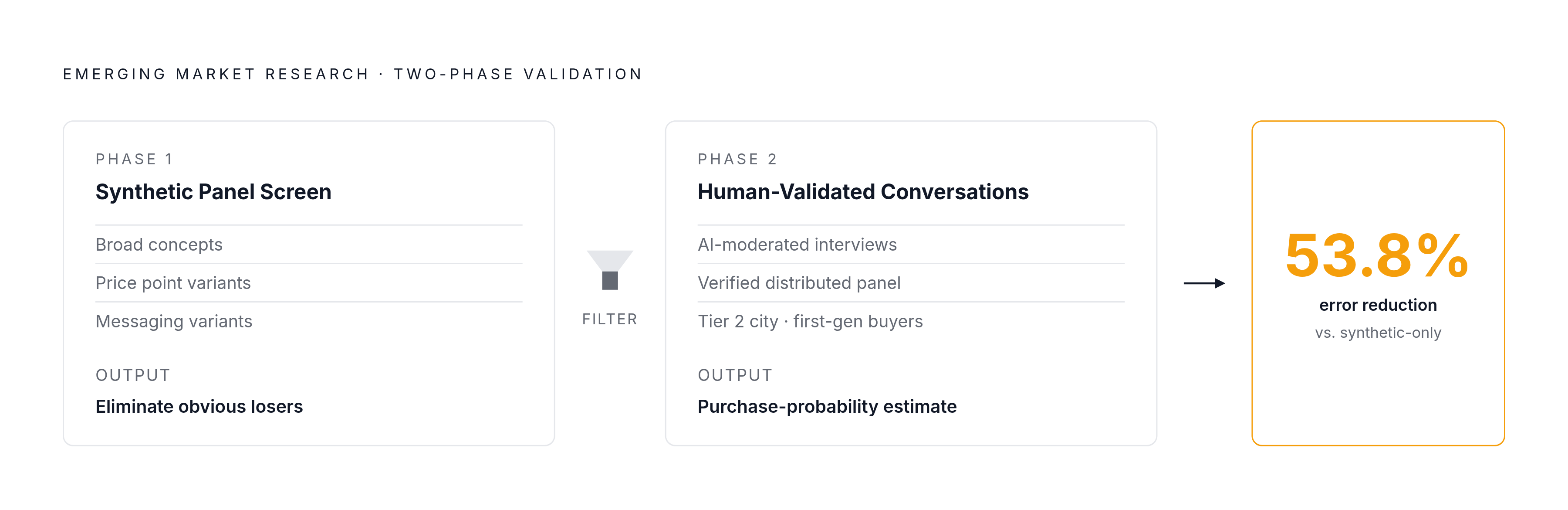
The practical response is a two-phase workflow that assigns each method a limited job. In the first phase, teams should run a broad set of concepts, price points, and messaging variants against a synthetic panel. The purpose is to eliminate obvious losers and identify candidates worth further investment.
The second phase should test the surviving options through AI-moderated conversations with real respondents from a verified, geographically distributed panel. Those interviews can confirm or contradict the synthetic findings, especially among Tier 2 city consumers and first-generation buyers. Contradiction is part of the value. Human validation is not a ceremony for approving what the model already said.
AI interviewers that probe and follow up can yield deeper qualitative insight than static surveys, especially where the context behind people's behavior and the nuances of their culture vary widely. The distinction is between recording an answer and exploring what lies behind it. A price preference, for example, tells a team more when the conversation also asks what people think the product is worth and what they can afford. The workflow preserves speed in exploration while reserving direct consumer contact for the questions a simulation cannot safely settle.
Why the AI-trust gap between Western and emerging markets changes the research instrument itself
Consumers do not approach an AI interviewer with the same expectations everywhere. AI chatbot usage in emerging markets is ahead of usage in Western markets, and familiarity changes how an AI-mediated conversation feels. An interview may feel more natural to a Brazilian or Chinese respondent than to an American one. The instrument is not socially neutral. The same interface can meet different levels of openness, comfort, or skepticism.
A research frame built around Western skepticism can therefore misread participation in faster-adopting markets. Greater openness to an AI conversation is not automatically evidence of the same attitudes toward every product or use of AI. Nor does it make emerging markets uniformly AI-positive. The variation affects how research is conducted and how the answers should be interpreted, rather than supporting a simple division between trusting and distrustful populations.
AI also changes the buying behavior being studied. Consumers are using it to surface new products, making AI discoverability a market entry variable. Research into how a brand appears in AI-mediated discovery is consequently becoming a category of its own. AI is both a way to ask the question and part of the consumer experience the question concerns.
How pricing and market entry decisions in emerging markets specifically require local behavioral data
Pricing exposes the cost of using the wrong evidence. A mature-market dataset may be extensive and still leave a behavioral gap in understanding what a first-generation buyer can afford or what a Tier 2 city consumer considers worth paying for. A price based on imported assumptions can miss both the buyer's affordability threshold and the value they attach to the offer.
For a team entering an emerging market, the starting point should be voice-of-customer research with locally recruited people. That research should establish perceived value and the affordability threshold, with margins and costs worked backward from what target customers can support. Synthetic-only panels cannot safely supply that foundation for underrepresented groups. Once teams have that local evidence, simulations can stress-test price options and how competitors might respond before the business commits.
AI-driven pricing is shifting from price tweaks made now and then to planned work that runs all the time, while category leaders are investing in simulation that goes beyond traditional elasticity modeling. A single APAC price or a single Africa price becomes harder to defend as teams can afford behavioral research in each country and city. The human evidence anchors the price, while the simulation examines the scenarios around it.
The organizational shift required to make continuous emerging market research possible
Faster tools alone do not lead to better decisions. Without infrastructure to absorb and use the findings, they can produce noise instead. The Qualtrics report documents that designers, product managers, and marketers are already gathering user insights. Research has spread across the organization. Teams still need a way to support research across the business without starting a new research engagement for every question.
In practice, teams need a platform that holds an audience model persistently, accepts new questions on demand, and integrates real-panel validation for high-stakes decisions. The model should be built on a verified human panel and validated through hybrid methods. That gives teams across the business research they can share in place of snapshots held by each team.
The payoff extends beyond the first market entry. A behavioral model can support later pricing changes, product extensions, and adjacent-market decisions without restarting recruitment for every question. High-stakes choices still require human validation, but the initial investment no longer ends with a deck. In markets adding consumers and changing quickly, research becomes a permanent strategic asset whose value grows through reuse, rather than a one-time cost that must be incurred again whenever the business needs an answer.
Sources
- The Future of Market Research: 13 AI and Insights Innovations to Watch — Greenbook
- 55% of Consumers Now Use AI During Product Discovery as Marketers Race to Keep Pace with a Faster, More Fragmented Consumer Journey
- Calibrated synthetic consumer panels for governed strategic market testing - ScienceDirect