Combining Gabor-Granger With Concept Testing in Early-Stage Research
One survey can show whether an idea is liked and whether it pays.

Embedding Gabor-Granger in concept testing lets early-stage teams test an idea’s appeal and revenue potential in one study, before committing to development. The case is simple. An idea that people like is not necessarily one they will pay enough for. A combined survey exposes that gap early, provided the concept is clear, the price range is plausible, and the results are treated as a screen.
Why concept testing and pricing research are usually run as separate studies, and what that costs
The conventional research funnel separates two questions that a business eventually has to answer together. First comes whether the concept resonates with buyers. Only after that does the team ask what those buyers might pay. The sequence has an understandable logic behind it. There seems little point in pricing a product no one wants, so concept validation comes first and pricing waits until the team has a clearer proposition.
That separation has a calendar cost as well as a research cost. Separate engagements need a new brief, new recruitment, and a new fielding window, so every handoff adds another stretch of work before a commercial decision is possible. In the meantime, the team may be refining a concept that has already passed its appeal test. That work starts before the team knows what buyers will pay. If buyers’ willingness to pay falls below the level needed to support a profitable product, that refinement becomes sunk effort, and the team discovers price viability too late.
What Gabor-Granger actually measures and why its output is useful earlier than convention assumes
Gabor-Granger asks respondents whether they would buy a product at a stated price. A yes leads to a higher price, while a no leads to a lower price or closes the sequence. Respondents can indicate whether they would buy using a binary response or a scale, but the wording must stay consistent across price levels. André Gabor and Clive Granger developed the method at the University of Nottingham, formalizing it in their 1964 paper “Price Sensitivity of the Consumer” in the Journal of Advertising Research.
The answers give a demand curve that shows purchase probability at each price. Multiplying demand by price gives a revenue curve, whose peak shows the revenue-maximizing price in the range tested. The slope adds another useful signal. A steep drop in demand shows price sensitivity, while a shallow curve suggests more room to charge a premium. These outputs are useful before feature lock because a concept is already a single proposition whose revenue potential needs testing. The method does not, however, measure choices between competing products, feature bundles, or pack-size configurations.
What concept testing is trying to establish before a pricing layer is added
Concept testing asks whether a given idea solves a real problem for the people it is meant for. It also asks whether the proposition appeals more than alternatives and which features or framings drive that appeal. This differs from finding out which needs or features buyers value in general. The proposition itself has to earn interest. Interviews and feature-prioritization work can establish what buyers care about without establishing that this particular product is worth developing.
A monadic design gives each respondent a single concept. That keeps reactions from being contaminated by comparisons with other concepts shown in the same session. Different concepts can still be assessed across separate groups. The distinction is between evaluating a proposition on its own and evaluating it after another idea has set expectations.
Someone can like the idea, recognize the problem it solves, and still refuse the price needed to make it viable. Appeal does not establish willingness to pay. A strong concept score therefore says something useful about the proposition, but not enough about whether the business can afford to deliver it.
How to structure a single instrument that runs concept testing and Gabor-Granger together
To build the combined survey, start by defining the price range before fielding. Category benchmarks and the cost structure provide its boundaries. A range that is too narrow can miss the point where demand changes sharply, while one that is too broad asks people to consider prices they would be unlikely to face. Sample design comes next. Find respondents who match the ideal customer profile, and get enough answers at each price point for a stable curve that shows the direction of demand.
Within the survey, show the concept first through a description, visuals, or a feature summary. Each respondent should see one concept in a monadic or split-sample design. Then ask about appeal and purchase intent without a price. That order keeps the price from shaping the unpriced baseline. Only after those answers are recorded should the pricing questions begin, so both measures refer to the same understood proposition.
For the price stage, the main choice is between a within-respondent ladder and a monadic price design. In the ladder, each respondent moves up or down according to the previous answer. It is faster and more sample-efficient. Randomizing the entry price across respondents distributes anchoring effects, but does not eliminate them. The first price can still shape how a respondent judges later ones.
With a monadic price design, different respondents see different prices, and their answers are put together to build the curve. This is the preferred approach when the sample budget permits, because each person’s response is not influenced by a series of previously shown prices. It requires a larger sample than within-respondent laddering. An optional question at the end can ask why someone stopped buying at a given price, helping to explain the appeal score and demand curve.
Reading the combined output and what the four appeal-and-price patterns mean for the go/no-go decision
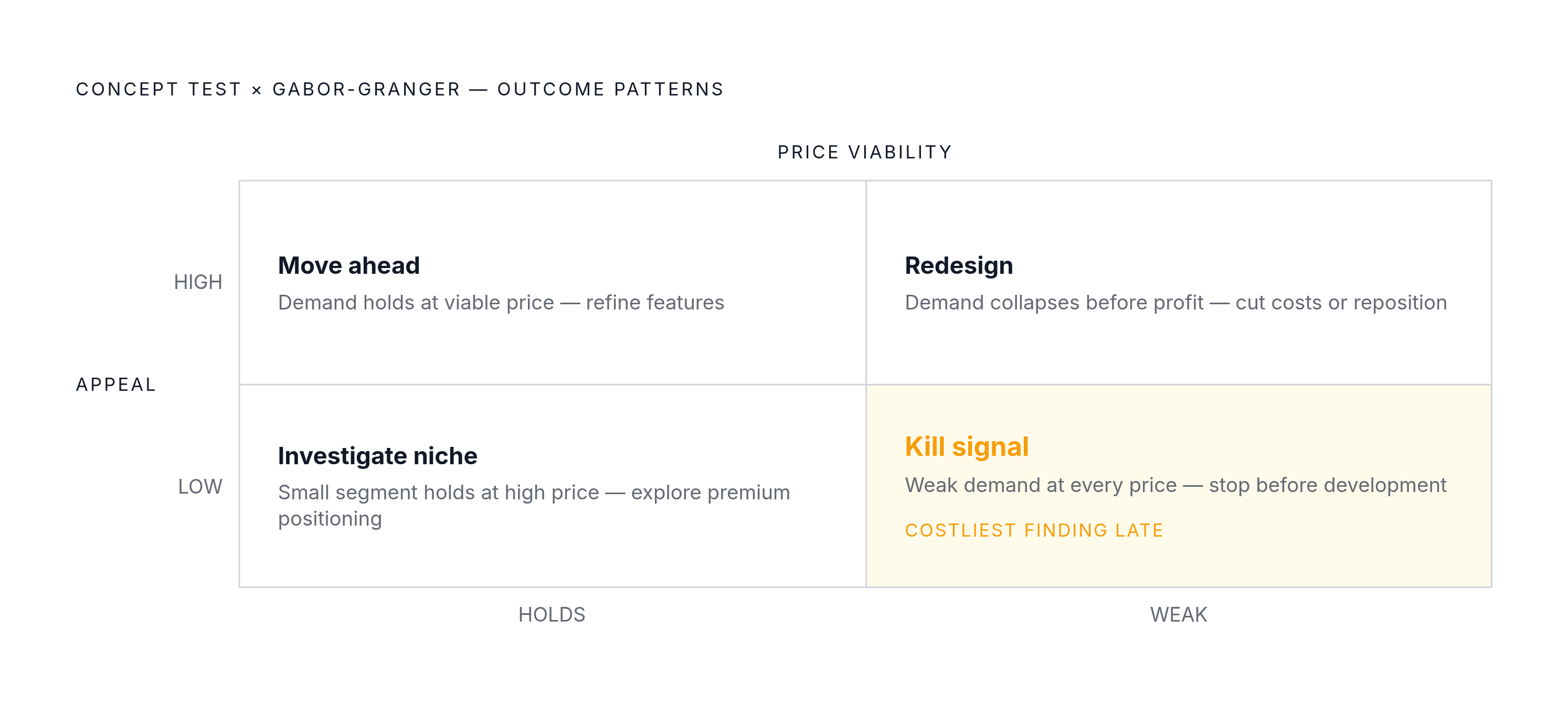
When appeal is high and demand holds across a price range that could support the business, there is a case for moving ahead. The next steps are feature refinement and a more rigorous pricing study. Both early tests have been passed. Buyers see the value of the proposition, and their stated purchase intent holds at prices that could support the business.
When appeal is high but demand collapses before the price is high enough to make a profit, the team needs to redesign, cut costs, or reposition the product before investing more. The idea has attracted interest without establishing a workable business. That distinction changes the next task. A steep drop across small price increases adds a warning that even a well-liked concept may be difficult to monetize in a price-sensitive market.
Low appeal with weak demand at every tested price is a kill signal. The concept has not established a job-to-be-done worth paying for, and price optimization cannot rescue that failure. Finding this before development is far less costly than finding it after a build.
Low overall appeal with demand that holds at a high price among a small segment points to a different decision. A targeted follow-up study can test whether there is a niche premium opportunity. The average may conceal a useful audience. Even so, all four patterns are directional screens, because a concept brief is a hypothesis and its demand curve remains a hypothesis-level read.
Where the combined approach breaks down and what to use instead
When the concept includes competing feature configurations or bundle options, Gabor-Granger is the wrong tool for resolving those choices. It holds the product constant and changes the price. Conjoint analysis instead tests trade-offs between features and prices. The same distinction applies when competitive context is essential. If the decision depends on what buyers choose from alternatives on a shelf or pricing page, choice-based conjoint or a competitive monadic design is needed.
Truly new concepts bring another problem because respondents have no experience of buying in the category. Their answers depend more heavily on imagining behavior they have not yet had reason to perform. Hypothetical bias grows with that distance from experience. Stated purchase intent can diverge from actual buying even in familiar categories, so novelty makes the combined study less dependable.
If the apparent revenue optimum sits at the boundary of the tested range, the curve is truncated and the peak may reflect the survey’s limits. The range needs scrutiny before interpretation. When no plausible range exists because there is no category benchmark or competitive anchor, Van Westendorp is the better first step. Its four open-ended questions establish an acceptable price corridor for later Gabor-Granger testing, though they do not remove the hypothetical bias of a novel concept.
Using synthetic consumer panels to pressure-test the combined instrument before committing to human fielding
Synthetic consumer panels offer a way to rehearse the combined survey before paying for human fieldwork. Teams can vary concept framing, price ranges, and competitive context to expose weak questions or implausible scenarios at near-zero cost and in hours. For example, if appeal stays high but purchase intent falls at every price, teams can check for a problem with the pricing structure before real respondents see the survey.
Structured pricing tasks in familiar categories are more promising for this use than questions about genuinely novel products. Willingness-to-pay bands and purchase-intent questions have clear behavioral analogues, and synthetic responses can show meaningful distributional similarity to human responses. That similarity does not establish commercial validity. A synthetic run can help teams choose which combinations to test with humans, without proving that those buyers will act as predicted.
A Monte Carlo proof-of-concept found that a calibrated hybrid design had less aggregate purchase-probability error and chose better concepts than either approach on its own. Its human-validation observations were simulated. That limits what the finding can support. AI-native platforms can compress fielding, synthesis, and reporting from weeks to hours, making a pre-screen operationally practical, but speed does not turn simulation evidence into validated decision infrastructure.
How the combined instrument fits into a broader early-stage research sequence
The combined study gives teams an initial pricing read at the same time as concept validation. Where those studies would otherwise run as separate engagements, it eliminates one recruitment cycle and one fielding window. It does not collapse the whole research program. Instead, it becomes a first gate that separates concepts to develop further from those to redesign or stop, before more specialized studies absorb time and budget.
The remaining methods still have distinct jobs. Conjoint is needed when pricing must account for both feature trade-offs and competitive choices, while Van Westendorp can set a price range when there is none. A behavioral purchase test, such as pre-orders, landing-page conversion, or a pilot sale, addresses the further gap between stated intent and real, committed behavior. Passing the combined study helps focus that next work, which is still needed.
The early findings also become inputs to later decisions. An appeal score and demand curve can inform feature prioritization, conjoint design, and go-to-market pricing rather than ending their useful life at the first gate. The research setup has value beyond one concept. Once the methodology and panel definition are established for a category, subsequent concepts cost less to study.